
How On-Demand Services Work
Flexible Solutions Tailored to Your Needs

On-demand services differ significantly from traditional scheduled transport: They do not follow a timetable with fixed routes and stops, but instead offer passengers a flexible door-to-door service, transporting them individually from their location to their desired destination.
They ensure comprehensive basic mobility provision in urban and rural areas and enable people with reduced mobility to participate more fully in society.
Attractive Mobility for Urban and Rural Areas

Ländlicher Raum - Flächendeckende Grundversorgung
Especially in rural areas, public transport provision is often inadequate. This is where on-demand services are particularly effective, as they address two problems at once: They offer an efficient alternative to infrequently used scheduled bus routes and call-a-bus connections, and can also serve flexibly as feeders to the next connecting service.
On-demand services close existing service gaps in rural regions or establish public mobility where none existed before.
On-demand services close existing service gaps in rural regions or establish public mobility where none existed before.
Urban Areas - Enhancing Public Transport Services in the City
Within urban areas, on-demand services also offer a reliable and safe transport service on demand, both at night and on weekends. In peripheral areas, they close gaps in existing local transport services and improve connections to the city center. In the city center, on-demand services provide a tailored, high-quality mobility option that approaches the comfort of a private car.
In this way, they represent an ideal complement to buses and trains, offering a better alternative, especially during off-peak hours and in areas with low demand.
In this way, they represent an ideal complement to buses and trains, offering a better alternative, especially during off-peak hours and in areas with low demand.
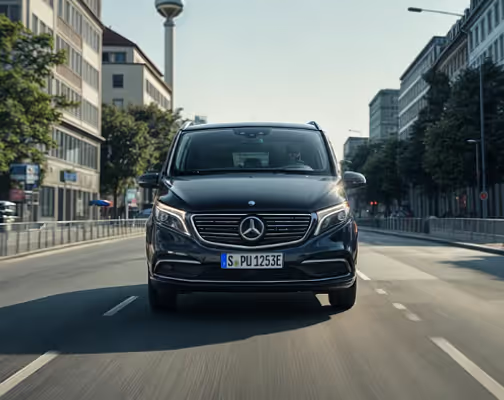
Attractive Mobility for Urban and Rural Areas
01/ Enhancing public transport by closing service gaps
By using on-demand services, gaps in existing public transport can be closed and new connections created. Public transport is often significantly reduced during off-peak hours, such as at night. On-demand services also offer a reliable and safe transport service during times of low demand.
02/ Complementing public transport by connecting to existing stops
transport passengers to connecting services on scheduled routes or bring them home from the train station (the so-called first and last mile). Public transport is often insufficiently available on the outskirts of cities. On-demand services close these gaps by connecting peripheral areas
03/ Replacing inefficient routes by substituting underutilized services
On-demand services offer an efficient alternative to infrequently used scheduled bus routes and call-a-bus systems. By using smaller vehicles and demand-oriented planning, costs can be reduced and emissions lowered.
04/ Public mobility for all through rapidly deployable accessibility
By using accessible vehicles, public mobility services become more comfortable, easier to use, and less cumbersome for people with reduced mobility. Seniors who don't own a car or no longer feel safe driving also gain access to a straightforward public transport option that provides door-to-door service with minimal waiting times.